Soft close is a feature, not a specification
A hardware line that reads “soft close hardware” has specified nothing. There are soft close hinges that cost a dollar and soft close hinges that outlast the kitchen, and between them lies most of the difference in how a cabinet feels in year five.
A real specification names the manufacturer and series, the hinge type with its opening angle and overlay, the slide type with its extension and weight rating, and the finish. Those are the facts that let you compare two quotes and the facts that let a replacement be ordered in eight years when one fails.
The weight rating is the single most overlooked item on that list. A drawer of pans, a drawer of tinned goods or a garage drawer of hand tools are among the heaviest things in a house, and a runner that is smooth when empty can bind or fail when loaded. Full extension runners with a stated rating are not a luxury on those drawers; they are the thing that determines whether the drawer still works.
What can be upgraded on cabinets you already own
Hardware is unusual among cabinet work in that a great deal of it retrofits. If the boxes are sound and the doors are fine, changing what you touch costs a fraction of changing what you see and often delivers more of the daily improvement.
| Upgrade | Retrofit feasibility | What is needed |
|---|---|---|
| Soft close hinges | Usually straightforward | A matching cup diameter and the same overlay. The door comes off, the hinge swaps, the door goes back on |
| Clip on soft close dampers | Almost always possible | A damper that clips to the hinge arm or mounts to the cabinet. Cheaper, slightly less refined |
| New pulls in existing holes | Possible if the hole centres match | Matching centre to centre spacing, or a backplate that covers the old holes |
| New pulls in new positions | Possible, with a consequence | Old holes filled and the fill visible unless it sits behind the new hardware or the door is refinished |
| Knobs to pulls | Usually requires new drilling | A single knob hole rarely lines up with a pull's two holes, so plan for filling |
| Soft close drawer runners | Often a bigger job | New runners, and sometimes a new drawer box if the existing one is not sized for them |
| Full extension runners | Depends on the existing box | Side clearance for the runner, and a drawer box built to the right width for it |
| Pull-out shelving in a cupboard | Usually possible | An internal frame or runners fixed to the carcass sides, plus clearance past the door hinge |
Certification marks, and what they actually tell you
For the metal, the relevant body is the Builders Hardware Manufacturers Association. Its own published description is precise and worth quoting in substance: it is the only organisation accredited by the American National Standards Institute to develop and maintain performance standards for locks, closers, exit devices and other builders hardware, it currently maintains more than forty ANSI and BHMA standards, and its A156 series describes and establishes criteria for builders hardware products including hinges.
Products in its certified directory have been through independent laboratory testing against cycle, operational, strength, security and finish requirements, and the programme is voluntary and open to manufacturers who are not members. That last point matters when reading a hardware box: an uncertified product is not necessarily poor, but a certified one has verifiable test results behind it. See the ANSI and BHMA standards overview→.
For the cabinet itself, the published standard is ANSI and KCMA A161.1. Certified cabinets have passed 14 tests including a 600 pound load test, and KCMA notes that between 40 and 50 percent of cabinets fail their first certification attempt. Certification exists at every price point, which makes it a floor rather than a luxury marker, and there is a separate Severe Use Certification originally developed by the United States Department of Housing and Urban Development for apartment kitchen wear. See the KCMA certification programme→.
Pulls, knobs and the grip question
Choose pulls over knobs wherever leverage matters, and that is a bigger category than appearance suggests. A pull gives two points of contact and a lever action, which moves a loaded drawer with less force and can be operated with a forearm, a knuckle or a wet hand. A knob requires a pinch grip.
In a household where somebody has arthritis, reduced hand strength or limited dexterity, that is the entire decision, and it should be made before the appearance conversation rather than after. The published accessibility guidance makes a related point about operable parts generally: the ADA Standards' forward reach range of fifteen to forty eight inches applies only to the operable portions of an element, so hardware position matters as much as hardware type. Those standards govern public accommodations rather than homes, so they are a design reference here rather than a requirement. See the US Access Board guide to operable parts→.
The practical rules are short. One pull per door and per drawer, two on drawers beyond about thirty inches so they do not rack. Pull length in proportion to the drawer, not to the catalogue photograph. And consistent hole centres across the kitchen, which makes future replacement trivial instead of a redrilling exercise.
Costs, and the arithmetic people get wrong
A Riverside cost page prices knobs and hinges at $2 to $4 each, and premium hardware supplies at $20 to $50 each. Those are per piece, and the number of pieces is where budgets go wrong.
Count the openings in your own kitchen. A modest kitchen has twenty to thirty doors and drawers; a larger one with an island and a tall run can exceed forty. Each door needs two hinges and one pull; each drawer needs a runner pair and one or two pulls. On forty openings at the premium end of that published range, the hardware alone is a four figure line before anybody fits it.
Fitting is the other half and it is skilled time. Hardware that is fitted but not adjusted looks worse than the hardware it replaced, because the eye reads uneven reveals before it reads anything else about a kitchen. Adjustment is why a hardware job takes longer than the component swap suggests.
Older Riverside cabinets, and what you find
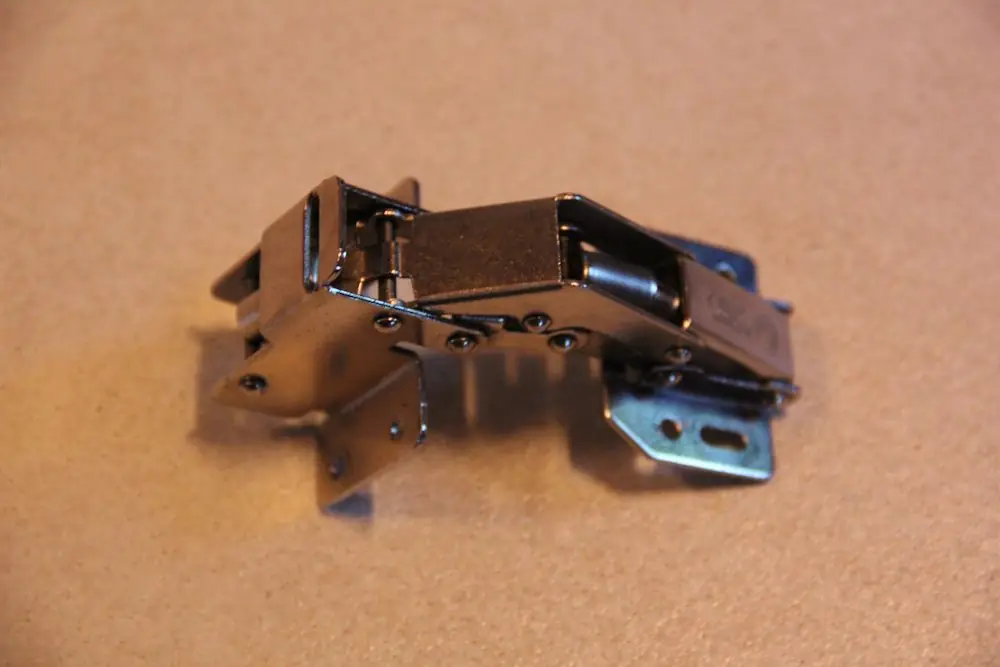
In a city where 56.5 percent of housing was built in 1979 or earlier on American Community Survey 2024 five year estimates, covering 2020 to 2024, a lot of original kitchen hardware is still in place, and it is usually one of three things. Surface mounted butt or semi concealed hinges on a face frame, which upgrade to concealed hinges only with new drilling. Older concealed hinges with a cup diameter that may or may not match current standards, which is a five minute measurement. Or a wrap around hinge, common on 1970s frame cabinets, which has its own replacement path. A photograph of an open door with the hinge visible answers nearly all of it.
Hinges, in the detail a quote should carry
A concealed hinge is described by four things, and all four belong on a quote because all four determine whether a replacement can be ordered in eight years.
Cup diameter. The hole bored in the back of the door. Thirty five millimetres is the common modern size, and older cabinets may use something else. This is the single measurement that decides whether an upgrade is a swap or a redrill.
Overlay. How much of the frame or carcass edge the closed door covers. Full overlay, half overlay and inset are different hinges, and changing between them changes the reveals across the whole kitchen, so it is a design decision rather than a hardware one.
Opening angle. Typically between ninety five and one hundred and seventy degrees. A wider angle matters most on a corner cabinet and on anything with a pull-out behind the door, because the door has to clear the opening before the pull-out can travel.
Mounting plate. The part fixed to the carcass, available in different heights to set the door's position. Plate height is one of the three axes of adjustment that let a fitted door be squared up afterwards.
Those three axes of adjustment, height, depth and lateral, are the reason a well fitted kitchen has reveals that line up. They are also the reason a hardware job is not finished when the last screw goes in. Adjustment is a separate pass, it takes time, and it is the difference between a kitchen that looks made and one that looks assembled.
How the project runs
- 1Identify what you already have
Hinge type and cup diameter, overlay, whether the cabinets are framed or frameless, and the existing drilling pattern. Hardware is one of the few cabinet jobs where a photograph and two measurements decide most of what is possible.
- 2Decide what the hardware has to do
A pull on a drawer full of pans is a different component from a knob on a display cabinet. Weight, frequency of use and who is using it, including anybody with limited grip strength, set the specification before appearance does.
- 3Check what can be reused
Many hinge upgrades fit the existing cup drilling, and many pull changes can use existing holes or be hidden by a backplate. Where neither is true, the choice is either a new drilling pattern with filled holes behind the hardware, or new doors.
- 4Specify by manufacturer and rating
Hinge type, opening angle, overlay and adjustment range; slide type, extension and weight rating. Soft close is a feature, not a specification, and a quote that says only soft close has not specified anything.
- 5Fit and adjust
Hardware is fitted and then adjusted, which is the half of the job that distinguishes a good result. Every door gets its reveals set and its closing checked, and every drawer gets its alignment and its self close trigger point checked.
- 6Check under real load
Drawers get loaded and run. A slide that is smooth empty and binds when loaded has either the wrong rating or an alignment problem, and the only way to find that is to load it.
What to check before you sign
- Manufacturer and series named for every hardware component, not just the phrase soft close
- Hinge opening angle and overlay stated, so replacements can be ordered later
- Slide extension and weight rating stated, particularly on pan and tool drawers
- The count of openings confirmed, because the arithmetic multiplies
- A plan for existing holes if the hole centres are changing
- Adjustment included in the scope rather than assumed, since that is half the job
- Consistent hole centres across the kitchen for future replacement
Related: soft-close and pull-out upgrades, cabinet refacing, and the hardware guide.