One difference, and everything follows from it
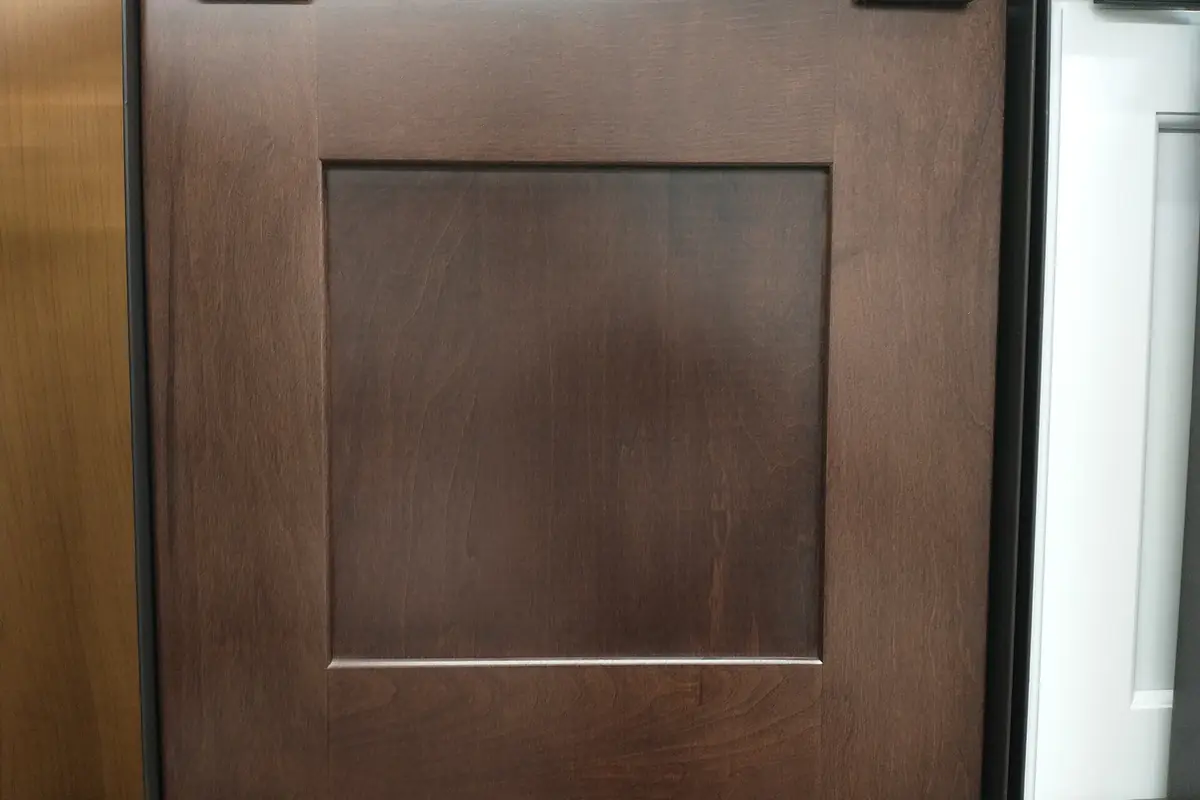
Paint is an opaque film sitting on the surface. Stain is absorbed into the wood. That is the whole difference, and almost every practical consequence follows from it.
Because paint hides what is underneath, a painted door can be made from several pieces of perfectly sound but unattractive timber, or from sheet material with no grain at all. Because stain makes grain more visible rather than less, a stained door needs attractive, well matched stock on every visible face, with the grain running sensibly and the colour consistent between pieces.
That is why a stained door costs more than a painted door of the same style from the same shop. It is not a mark up on fashion; it is the material. Paint grade and stain grade are genuinely different specifications of timber, bought at different prices.
| Painted | Stained | |
|---|---|---|
| What it does to the material | Hides it | Shows it |
| Timber required | Paint grade: sound, stable, straight. Appearance irrelevant | Stain grade: attractive, matched, consistent in colour |
| Typical substrate | Poplar, maple, or MDF for the panel and sometimes the whole door | Solid hardwood throughout on visible faces |
| Cost in the same style | Lower, because the material is cheaper | Higher, because the material is selected |
| How it fails | Chips at edges; a frame joint can telegraph through the film as the wood moves | Wears thin at contact points; shows water marks and sun fading |
| Repairability | A chip can be filled and touched in, but matching a flat colour exactly is harder than it sounds | Generally easier to repair invisibly, because the surface is already varied |
| Changing it later | Repainting is straightforward with proper preparation | Going darker is easy, going lighter means stripping |
| What it does in a dark room | A pale painted kitchen bounces light around | A stained kitchen absorbs it, which reads warmer and smaller |
The species decision is really a finish decision
People usually choose a species and then a finish. The order works better reversed, because the finish eliminates most of the species options immediately.
If the finish is paint, species is almost irrelevant to appearance and entirely relevant to stability and durability. Yellow poplar at 0.00289 tangentially is the classic choice: cheap, stable, machines cleanly, and soft enough to dent. Maple is harder and more dent resistant. MDF is the most stable option of all and has no grain to telegraph, which is why so many painted doors use it for the panel at minimum.
If the finish is stain, species becomes the whole decision, because the grain is what you will be looking at. Red alder takes stain evenly and sits at the calm end of the movement table at 0.00256. Black cherry at 0.00248 is one of the most stable cabinet hardwoods and darkens with light exposure, which matters on a kitchen that takes afternoon sun. Red oak at 0.00304 has an open grain that reads strongly. White oak at 0.00376 is beautiful and the most active of the common choices, which matters on a wide panel.
One practical warning. Maple can finish blotchy under a stain without a conditioner, because it absorbs unevenly. That is a known characteristic rather than a fault, and it is one of the main reasons maple appears more often painted than stained.
What the air district allows
Riverside sits inside the South Coast Air Quality Management District, which names the city on its own published jurisdiction list, and two of the district's rules decide what can legally be applied to cabinets here. This is not an abstraction: it determines which products a shop or a painter is allowed to buy.
| Category | Limit |
|---|---|
| Wood coatings | 275 |
| Varnish | 275 |
| Sanding sealers | 275 |
| Lacquer | 275 |
| Stains, interior | 250 |
| Wood conditioners | 100 |
| Stains | 100 |
| Primers, sealers and undercoaters | 100 |
Table of Standards 1, grams of VOC per litre of coating less water and less exempt compounds. Rule 1113 was amended 5 February 2016.
| Category | Limit |
|---|---|
| Clear primers, sealers and undercoats | 275 |
| Pigmented primers, sealers and undercoats | 275 |
| Clear topcoats | 275 |
| Pigmented topcoats | 275 |
| Fillers | 275 |
| Other coatings | 275 |
Table 1 regulatory limits. Rule 1136 was adopted 16 September 1983 and most recently amended 5 June 2026. Its definitions name cabinets, kitchen, bath and vanity, explicitly, and the rule does not apply to residential non commercial operations.
The practical consequence is that waterborne catalysed systems dominate professional cabinet finishing in this district, for both paint and clear coats, because they perform well within a 275 gram per litre ceiling. It is also a genuine reason a quote from a shop outside the district can look cheaper on paper. The rule book is published at South Coast AQMD Regulation XI→, and the finishing guide reproduces both tables in full.
Shop finishing against site finishing
Shop finishing wins, for reasons that have little to do with the skill of the person holding the gun.
A shop sprays doors flat, on a horizontal surface, off their hinges, in a space where the dust is controlled and the temperature is reasonably stable. Gravity helps rather than hinders, overspray goes into extraction rather than onto the floor, and the door can be left undisturbed while it cures.
An occupied kitchen is the opposite of all of that. The doors are vertical, the room has to be masked, the household has to be somewhere else, and the air carries whatever is outside. In an inland city with dry hillsides and seasonal winds, September in Riverside is not a good spraying environment with the windows open.
Site finishing still has a place. Touching in after installation, finishing a scribed filler that was cut on site, and refinishing existing cabinets where removal is not practical are all legitimate. What it should not be is the default for new doors.
Repainting what you already have
Repainting existing cabinets is a real option and frequently a good one, and it has one legal condition in most of this city.
Preparation is the whole job. Degreasing, sanding to a key, filling, priming appropriately for the substrate, and only then painting. Cabinets that have been cooked around for decades carry a film that nothing will adhere to, and a finish applied over it will fail at an edge within a year. The visible result of good preparation and bad preparation looks identical on day one.
The legal condition is lead. In a home built before 1978, sanding painted surfaces is covered work under the federal renovation, repair and painting rule, and the firm doing it must be certified with employees trained in lead safe work practices. The minor repair exemption covers six square feet or less of paint per room inside, which a kitchen passes in minutes. With 56.5 percent of Riverside housing built in 1979 or earlier on American Community Survey 2024 five year estimates, covering 2020 to 2024, this applies to most houses here. See the EPA renovation, repair and painting page→.
Living with each one
Specification arguments are easy to make in the abstract. What actually decides whether somebody is happy with a finish is the five years after it goes in, so here is what that looks like for each.
A painted kitchen shows damage as contrast. A chip in a pale painted door reveals the substrate underneath, which is a different colour, so a small chip is visible from across the room. The flip side is that touching it in is possible and reasonably easy; getting an exact colour match on a finish that has aged slightly is the harder part. Painted kitchens also show grease and fingerprints more readily on a satin finish than on a stained one, which is a cleaning frequency difference rather than a durability one.
A stained kitchen shows wear as thinning. The places people touch, the edge beside the hob, the front of the drawer under the sink, the door by the bin, gradually lose colour and sheen rather than chipping. That is a slower and less jarring failure, and it is also more repairable in place: a stained surface can be cut back and recoated locally far more convincingly than a flat colour can.
Sunlight treats them differently. On a kitchen that takes strong afternoon sun, which in this region describes a great many west facing rooms, a stained finish will change colour over years. Some species darken, notably black cherry, and some fade. That is not damage and in cherry it is generally considered an improvement, but it does mean that a door replaced in year eight will not match its neighbours. Paint is more stable in colour, although pale colours can yellow slightly depending on the system.
Repairs age differently. A stained repair blends into an already varied surface. A painted repair sits on a uniform one, which is why it needs to be good. Neither is a reason to choose one over the other; both are reasons to keep a small quantity of the finish after the job, which any shop will supply if asked at the time and almost none will supply two years later.
How to decide
- Decide the finish before the species, because the finish eliminates most of the species options
- If painting solid timber doors, ask directly what happens at the frame joints as the wood moves
- If staining, look at a sample of the actual species with the actual stain on it, not a photograph
- If staining maple, ask about blotching and whether a conditioner is being used
- Ask for the finish system by name and by coating category, not just a colour
- Ask whether doors are finished in a shop or on site, and why
- If the house predates 1978 and existing cabinets are being prepared, ask for the firm lead certification
Neither choice needs a permit, and that cuts both ways
Painting or staining cabinets is exempt from a building permit in Riverside, and the City lists it explicitly. Its Building and Safety Division handout WORK EXEMPT FROM BUILDING PERMITS→ includes among finish improvements both “Cabinet refacing or replacement without changing walls, plumbing, or electrical configurations” and, as its own numbered item, “Painting”.
The useful part is what the City prints alongside it: “Exemption from the permit requirements of this code shall not be deemed to grant authorization for any work to be done in violation of the provisions of the technical codes or any other laws or ordinances of this jurisdiction.” No permit means no inspection, not no rules. The coating limits set out above still bind whoever sprays, whichever finish you choose, and the only person checking is you.
That makes the painted against stained decision partly a verification decision. A paint system on cabinetry is a primer, a sealer and two topcoats, each with its own coating category and its own limit; a stained system adds a stain and a conditioner with different limits again. Ask for the category and the grams per litre for every layer rather than for a brand and a colour. The answer takes a competent finisher thirty seconds and tells you more about the quality of the work than any sample door will.
Related: the species guide, door styles and overlays, and refacing against refinishing against replacing.