Overlay first, style second
Overlay is how much of the cabinet frame or carcass edge the closed door covers, and it decides the character of a kitchen more than the door style does. It is also the harder decision to change later, because it determines the hinge type and the reveals across the entire run.
Full overlay. The door covers nearly all of the frame or carcass edge, so what you see is almost entirely door, separated by narrow consistent gaps. This is the modern default and it is what most new kitchens look like. It demands accuracy, because with a narrow reveal any inconsistency is obvious.
Partial or half overlay. The door covers part of the frame, leaving a visible band of frame between adjacent doors. It is more forgiving of variation and it reads as more traditional. It was the standard for decades and it is what most older American kitchens have.
Inset. The door sits within the frame, flush with its face. It is the most demanding construction in the trade, because the gap around the door is visible on all four sides and has to be consistent, and because the door has to stay within tolerance as the wood moves. It costs more and it is the construction that most clearly reads as handmade.
The six door styles
| Style | Construction | Cost driver | Cleaning | Movement tolerance |
|---|---|---|---|---|
| Slab | One flat piece, sheet material or a veneered panel | Cheapest to make; cost is in the material and the edge treatment | Easiest. No profile for anything to sit in | Highest, because sheet material barely moves |
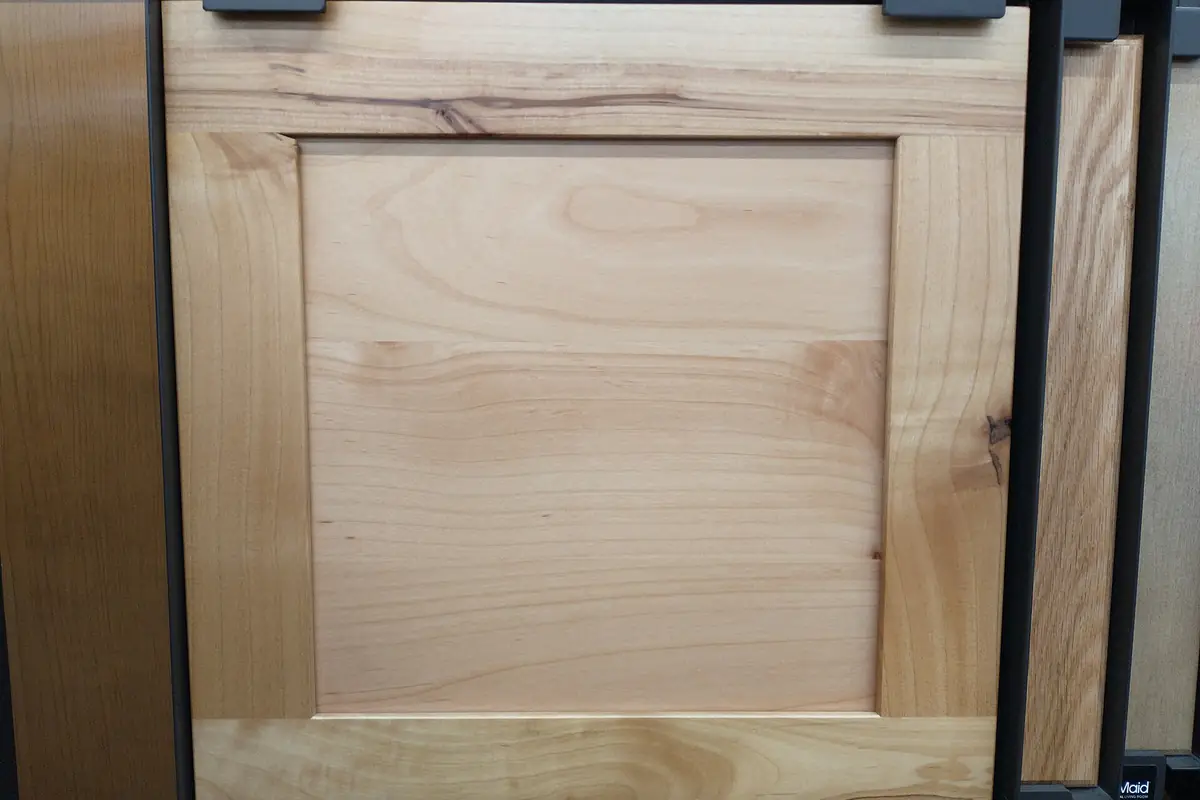
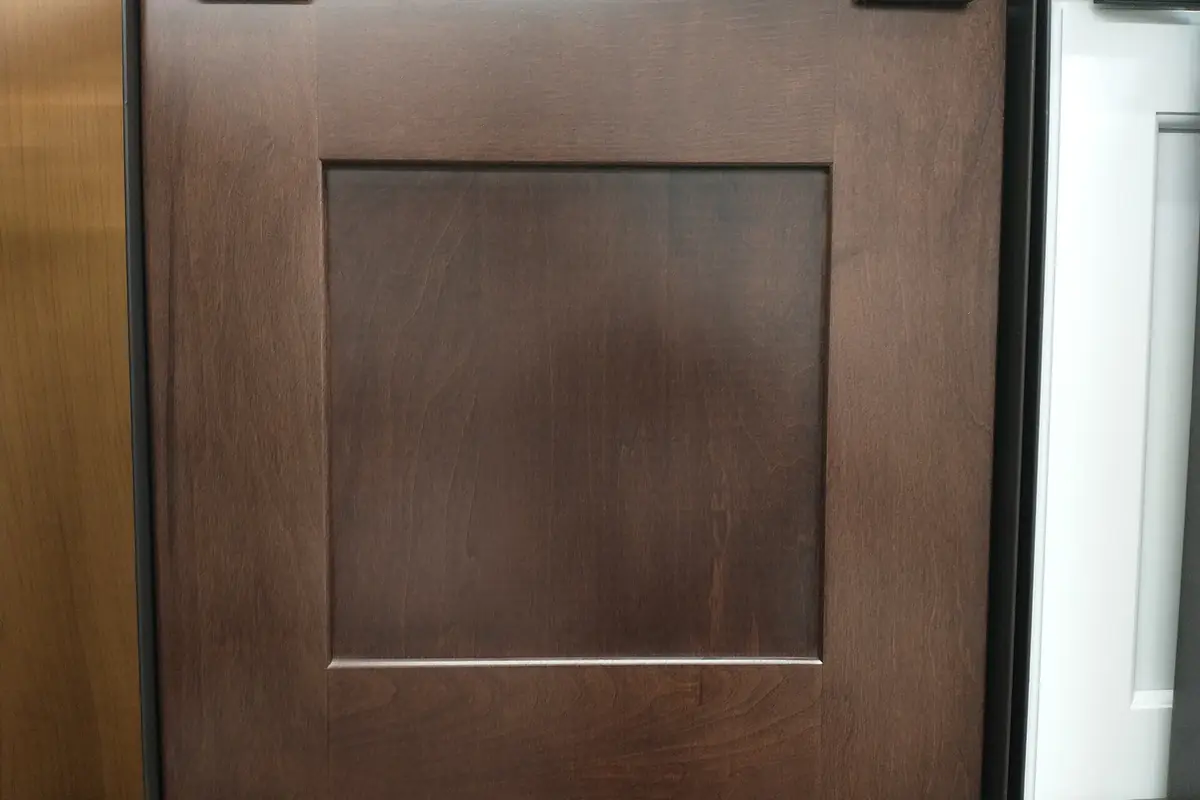
| Shaker | Five pieces: four frame members and a flat floating panel, square edged | Five pieces and a grooving operation | One internal corner collects a line of grease | Good. The floating panel can move freely |
| Recessed panel | As shaker but with a moulded profile on the inner frame edge | Additional machining on the frame | More profile to wipe, in the same corner | Good, same construction |
| Raised panel | Five pieces with a shaped panel standing proud, often with a frame profile too | Most machining of the solid styles | Several profiles, the most work to keep clean | Good construction, but the panel is often wide, so species matters |
| Mullion or glass | Frame with glazing bars, rebates and glass | Glazing bars, rebating, glass and often a finished interior behind it | Glass is easy, glazing bars are fiddly | Good, though glass does not move and the frame does |
| Louvre | Frame with angled slats | Many pieces, lots of assembly | The hardest to clean of any style | Good, but rarely used in kitchens for the cleaning reason |
Where the cost actually is
Door cost tracks piece count and machining time far more closely than it tracks fashion. A slab door is one piece with an edge treatment. A shaker door is five pieces, a grooving operation and an assembly. A raised panel door adds shaping on the panel and often on the frame. A mullion door adds glazing bars, rebates and glass.
The second cost driver is the material, and on a stained door that interacts with the style. A stained raised panel door needs attractive, well matched timber across five visible pieces. A painted door of the same style can use less attractive stock because the paint covers it, which is why paint grade and stain grade are different prices for the same shape.
The third is quantity, and it is worth counting before you choose. A kitchen has more openings than cabinets, because drawers count. Twelve cabinets can easily be eighteen or twenty openings once drawer fronts are included, and the door choice multiplies against that number rather than against the cabinet count.
Movement, and why the panel floats
Every frame and panel door exists because of wood movement. The panel sits in a groove in the frame and is deliberately not glued in, so it can expand and contract across its width without splitting itself or the frame. A panel glued into its frame will do one of those two things, and it is the commonest construction error in cabinet doors.
How much movement there is to accommodate depends on the species, and the federal figures vary several fold. The table below gives the relevant comparison for door panels.
| Species | Radial | Tangential | Note |
|---|---|---|---|
| Maple, sugar | 0.00165 | 0.00353 | The default paint grade and clear coat hardwood in this market. Hard, tight grained, and it moves more across the grain than alder or cherry. |
| Alder, red | 0.00151 | 0.00256 | The quiet performer for stained work. Low tangential movement, takes stain evenly, dents more easily than maple. |
| Cherry, black | 0.00126 | 0.00248 | One of the most dimensionally stable cabinet hardwoods on the table, and it darkens in sunlight, which matters on a south facing Riverside kitchen. |
| Oak, white | 0.00194 | 0.00376 | Heavy, open pored, and near the top of the table for movement. Beautiful, but panels need room. |
| Hickory, true | 0.00259 | 0.00411 | The most active wood most homeowners will consider. Spectacular grain, and the least forgiving choice for a wide flat panel. |
| Poplar, yellow | 0.00158 | 0.00289 | Paint grade only. Cheap, straight, machines cleanly, and it dents if you look at it hard. |
Dimensional change coefficients per one percent change in moisture content, USDA Forest Service Wood Handbook Table 13-5. Tangential is the across the grain figure and the one that matters in a door panel.
Three construction choices follow from that table. A wider frame reduces the panel width, which reduces the movement. Several narrow panels in one door move less each than one wide panel. And quarter sawn stock moves on the radial figure rather than the tangential one, which across this table is often less than half.
Full detail on all sixteen species is in the species guide, and the source tables are at the USDA Wood Handbook moisture chapter→.
Choosing a style for the house you actually have
The most reliable way to choose a door style is to read the joinery already in the building rather than to start from a photograph of somebody else's kitchen.
Look at the internal doors, the skirting profile and the architrave width. Those three set the visual language of the house, and a kitchen that picks them up reads as belonging. In a 1920s or 1930s bungalow with substantial trim, a shaker or a recessed panel door in a partial overlay or inset agrees with it. In a 1970s tract house, which is close to the median in this city given 56.5 percent of the stock predates 1980 on American Community Survey 2024 five year estimates, covering 2020 to 2024, a slab or a simple shaker in full overlay usually looks more intentional than something trying to be older than the building.
A deliberately contemporary kitchen in an old house can be excellent. What rarely works is a kitchen that is trying to look traditional and getting the proportions wrong, which is almost always a matter of frame widths and reveals rather than of style.
Finish, and why doors are usually shop finished
Door style and finish are chosen together, because a painted finish forgives a frame joint that a stained finish exposes. In Riverside the finish is also regulated: the city sits inside the South Coast Air Quality Management District, whose Rule 1113 caps coatings applied on site at 275 grams of VOC per litre for wood coatings, varnish, sanding sealers and lacquer, and 250 for interior stains. Shop finishing is better anyway, because the door is sprayed flat, off its hinges, in controlled dust, but the rules are a second reason it dominates. The finishing guide reproduces both district rule tables.
Reveals, and why they are what the eye actually reads
The reveal is the gap around and between doors. It is the single most reliable indicator of whether a kitchen is well made, and it is the thing almost nobody consciously looks at while being the thing everybody notices.
On a full overlay kitchen, reveals are narrow, which makes any inconsistency obvious. A run of doors where the gaps vary by a couple of millimetres reads as cheap even when the doors themselves are excellent, because the eye compares adjacent gaps without being asked to. On a partial overlay kitchen the frame between doors does some of that work, which is part of why partial overlay is more forgiving.
Getting reveals consistent is an adjustment pass rather than a fitting pass. Concealed hinges adjust in three axes, height, depth and lateral, and setting them is skilled time that takes place after everything is hung. A kitchen that has been fitted and not adjusted will have doors that close and reveals that do not line up, and it will look worse than the kitchen it replaced however good the doors are.
The practical consequence for a homeowner choosing doors is to ask whether adjustment is in the scope. It is a line on a quote, it is real work, and it is the difference between a kitchen that looks made and one that looks assembled.
Hardware, which is chosen with the door not after it
Door style, overlay and hardware are one decision made three times, and separating them is how a kitchen ends up with pulls that fight the doors.
Overlay sets the hinge. Full overlay, half overlay and inset are different hinges with different mounting plates, and an inset door needs a hinge designed for it. That is why the overlay decision has to precede the hardware decision rather than follow it.
Door style suggests the hardware scale. A slab door in full overlay often carries a long pull or an integrated edge pull, because there is no frame for a knob to sit on comfortably. A shaker door has a frame, which gives a knob or a short pull a natural position. A raised panel door in a traditional kitchen will usually take a knob on doors and a cup pull on drawers, which is a convention rather than a rule but a convention the eye expects.
Drawer width sets the pull count. Anything beyond roughly thirty inches wants two pulls, because a wide drawer pulled from one end racks on its runners and feels heavy. That is a mechanical fact rather than a styling one, and it is worth deciding before the hardware is ordered.
Consistent hole centres across the kitchen make a damaged pull a two minute replacement in five years instead of a redrilling exercise. That is worth specifying even where the hardware itself is modest.
What to settle before ordering doors
- Overlay: full, partial or inset, decided before the style because it sets the hinges and the reveals
- Style, chosen against the trim already in the house rather than from a photograph
- Frame width on a frame and panel door, which changes both the look and the panel width
- Panel construction, specifically that the panel floats and is not glued into the frame
- Species, checked against the published movement figures if the panel is wide and the finish is stain
- Paint grade or stain grade, because that decides what the frame can be made from
- The actual opening count, including drawer fronts, since the choice multiplies against that
- A physical sample seen and handled, because the words shaker and recessed panel are used loosely
Related: painted or stained, the species guide, and cabinet refacing, which is where most door style changes actually happen.