What Corona's housing data says about cabinet work
Corona's median housing unit was built in 1991, which puts the middle of its stock fifteen years newer than Riverside's, and the consequences for cabinetry are concrete rather than abstract. Newer framing is squarer, newer kitchens were drawn around appliances that still exist, and far fewer houses sit on the wrong side of the federal lead paint threshold.
But the city is genuinely split. 24.6 percent of its 50,799 housing units were built in 1979 or earlier and 6.5 percent before 1960, which in absolute terms is thousands of older houses in the original parts of the city. Meanwhile 25.0 percent went up in 2000 or later. Those two groups need different work.
| Measure | Corona | Riverside, for comparison |
|---|---|---|
| Population | 159,670 | 319,069 |
| Housing units | 50,799 | 99,910 |
| Median year built | 1991 | 1976 |
| Built 1979 or earlier | 24.6% | 56.5% |
| Built 1959 or earlier | 6.5% | 26.7% |
| Built 2000 or later | 25.0% | 19.2% |
| Owner occupied | 63.8% | 56.8% |
| Median owner occupied value | $700,700 | $584,800 |
| One unit detached | 65.6% | 63.7% |
United States Census Bureau, American Community Survey 2024 five year estimates, covering 2020 to 2024. Tables B01003, B25001, B25003, B25024, B25034, B25035 and B25077.

The older half: original Corona
Corona's older housing clusters around the original city, and it behaves the way older housing behaves everywhere in this region. Framing has moved, walls bow, ceilings drop across a run, and a cabinet dimension taken from a plan will not match the dimension taken from the wall. That is the case for scribed custom cabinetry rather than catalogue boxes with filler strips.
It is also the case for taking the lead question seriously. 24.6 percent of Corona's housing was built in 1979 or earlier, which means a substantial number of homes fall under the federal renovation, repair and painting rule. Anyone paid to disturb painted surfaces in a home built before 1978 must be a certified firm using lead safe work practices, the requirement reaches sole proprietors, and the minor repair exemption of six square feet or less of paint per room inside is passed as soon as a run of painted cabinets comes off a wall. The programme is administered in California by the EPA directly. See the EPA renovation, repair and painting page→.
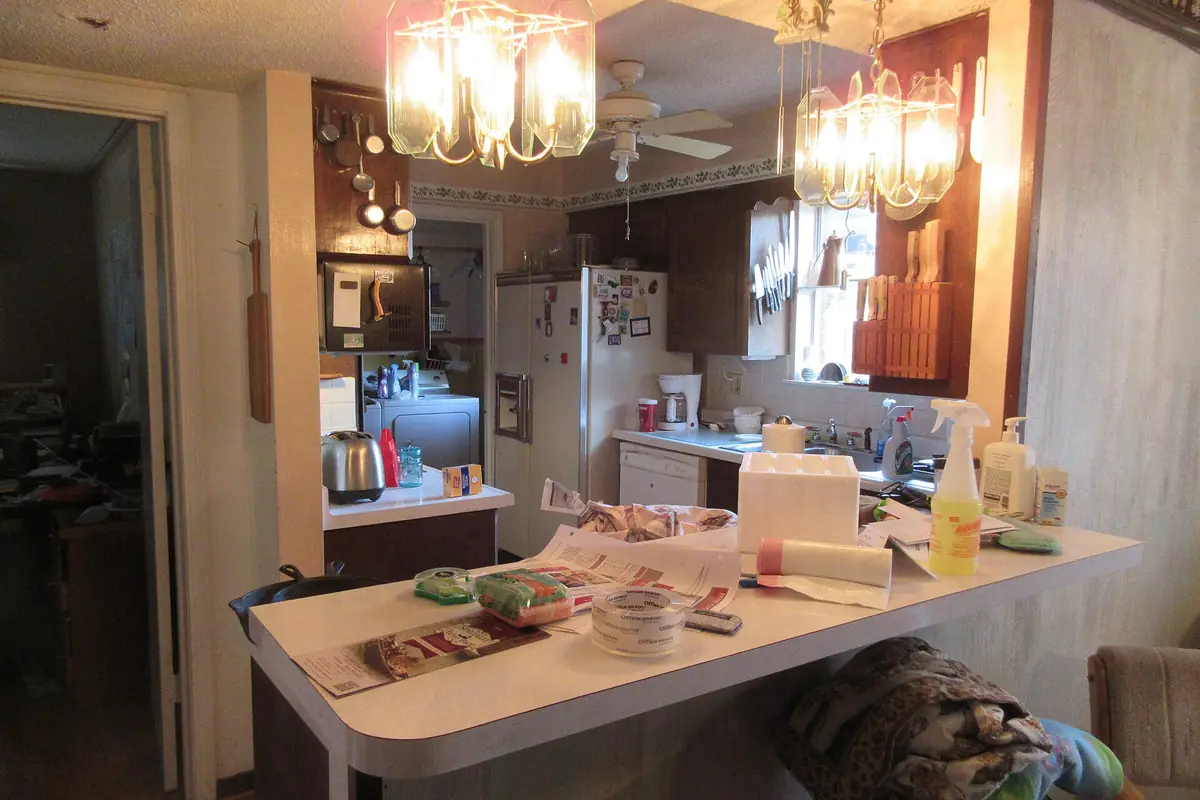
The third thing older Corona kitchens tend to need is a layout change rather than a cabinet change. A kitchen drawn before dishwashers were standard has no good home for one, no landing space beside the oven and no designed waste position. Those are cabinet schedule problems, and refacing cannot fix any of them.
The newer half: 1990s onward
With 25.0 percent of Corona's stock built in 2000 or later and a median year of 1991, a large share of this city's kitchens are in rooms that are reasonably square, with layouts drawn around modern appliances. That changes the honest recommendation.
In a house like that, semi-custom cabinetry at $150 to $900 and up per linear foot, installed frequently delivers most of what custom would, because the catalogue widths fit the walls with modest filler. Paying the custom premium of $500 to $1,400 and up per linear foot, installed buys genuine value where the room is unusual, where the ceiling height is worth using, or where a specific species matters, and less value where the room is a standard rectangle.
What newer Corona houses almost universally do need is better cabinet interiors. Builder grade kitchens are fitted out with base cupboards containing a single fixed shelf, which is the arrangement that puts half your storage out of reach. Converting those to pull-outs and adding soft close is hardware rather than joinery, costs a fraction of replacement, and changes daily use more than new doors would.
What costs what
| Work | Published figure | Unit | Geography |
|---|---|---|---|
| Custom cabinetry | $500 to $1,400 and up per linear foot, installed | Per linear foot installed | National |
| Semi-custom cabinetry | $150 to $900 and up per linear foot, installed | Per linear foot installed | National |
| Stock cabinetry | $75 to $400 and up per linear foot, installed | Per linear foot installed | National |
| Installer labour | $50 to $70 per linear foot | Per linear foot | National |
| Laminate refacing | $1,439 to $2,266 | Twelve cabinet kitchen | Riverside, CA, the nearest published local figure |
| Custom made replacement | $15,000 to $20,000 | Per kitchen | Riverside, CA, the nearest published local figure |
Published reference ranges read at build time. The refacing and replacement rows are Riverside figures, not Corona figures, and are labelled accordingly because no equivalent Corona page was found.
Permits, and the jurisdiction point
Cabinet replacement in the same footprint is finish work exempt from permit under the California Residential Code, which every jurisdiction in the state starts from. The exact exempt list item reads “Painting, papering, tiling, carpeting, cabinets, counter tops and similar finish work.”, and you can read the state level version at the California Residential Code exempt work section→.
A point of accuracy this site insists on: Corona is its own jurisdiction with its own building division, and local jurisdictions are permitted to amend the state exempt list. The version quoted throughout this site is the City of Riverside's, because that is the page we read at source and verified. For a Corona address, confirm with the City of Corona's building division rather than assuming the neighbouring city's republication applies.
What is true everywhere: moving a sink is plumbing, adding or relocating circuits is electrical, relocating a gas range involves gas work, and removing a wall is a building permit and a structural question.
Air district rules apply here too
Corona is named on the South Coast Air Quality Management District's own published jurisdiction list, alongside Riverside, Norco, Eastvale, Jurupa Valley, Moreno Valley, Perris, Menifee and Lake Elsinore in Riverside County. That means the district's coating rules apply to any shop or painter finishing cabinets for a Corona house: Rule 1136 for shop applied wood coatings and Rule 1113 for coatings applied on site. Both cap most relevant categories at 275 grams of volatile organic compounds per litre. The district publishes its member city list→, and the finishing guide reproduces both tables.
Where Corona sits in the service area
Corona sits at the western edge of Riverside County at the mouth of the Santa Ana Canyon, with Norco immediately north and Eastvale north west, both of which have their own pages here and both of which have completely different housing profiles. Norco is 66.8 percent pre 1980 housing on large lots; Eastvale is 92.7 percent built since 2000. Corona sits between those two extremes, which is a reasonable summary of the city generally.
The practical local factors worth noting are dust and sun. The canyon mouth is a wind path, which is an argument for closed shoe storage at entrances rather than open cubbies, and a great many Corona houses take significant afternoon sun on one elevation, which is worth knowing when deciding which wall a pantry should not go on.
The three Corona projects we are asked about most
The builder kitchen upgrade. A house from the late 1990s or 2000s with cabinets that are structurally fine and interiors that are not. The work is pull-out conversions in the base cupboards, a designed waste pull-out beside the sink, soft close across every door, and frequently new doors or refacing to change the look. The carcasses stay, which is why this is a fraction of the cost of replacement and why it is the right recommendation far more often than the industry admits.
The older Corona kitchen redraw. A house from the 1960s or 1970s where the complaint is partly the cabinets and mostly the layout. This is a cabinet schedule job: the refrigerator opening gets resized to an appliance that exists, a waste pull-out gets a home, the blind corner gets resolved, and the uppers run to the ceiling instead of stopping at a dusty shelf. Scribed custom boxes, because the walls will not be straight, and a lead safe certified firm for the removal.
The storage project. Closets, pantry, garage and laundry, in houses of any age. This is consistently the work that changes daily life the most per dollar, because the builder standard for all four of those rooms is poor everywhere and because the materials are modest. In a newer Corona house with a large garage and a walk-in closet fitted out with one rail and one shelf, there is a great deal of volume going unused.
What we do here
- Custom and semi-custom kitchen cabinetry, with the tier recommended against the age and squareness of the room
- Bathroom vanities built to the actual wall, which is where catalogue widths miss most often
- Built-ins, media walls and home office joinery
- Closet, pantry, garage, laundry and mudroom storage, which in newer Corona housing is often the best value work available
- Cabinet refacing where the carcasses are sound and the layout works
- Pull-out conversions and soft close upgrades to builder grade cabinets
- Countertops, templated off installed cabinets rather than off a drawing
- Commercial millwork for Corona business premises
Household size in Corona, and what it changes
Corona households average 3.22people, within a hundredth of Riverside’s 3.21, so the raw volume of storage a Corona kitchen has to hold is typical for this region rather than unusual. What is not typical is the gap between tenures. Owner occupied Corona households average 3.39 people and renter occupied ones average 2.93, a spread of nearly half a person, and that is the largest tenure gap of any Riverside County city on this site apart from Jurupa Valley.
Household size is not a vanity statistic in cabinet work. It sets four things directly: how many linear feet of pantry shelf the kitchen needs, how many cutlery and utensil drawers are worth having rather than one, how big the waste and recycling pull out has to be before it needs emptying daily, and how much dish storage sits within reach of the dishwasher. A kitchen drawn for three and a half people and a kitchen drawn for two and a half are not the same kitchen with different doors.
The practical Corona version: in the owner occupied stock, which is 63.8 percent of the city, plan the waste pull out at the larger end and put a genuine pantry in rather than a cupboard called one. In the rental and condominium stock, the constraint is usually the opposite, because the room is smaller and the useful win is drawer banks instead of deep cupboards that swallow things.
| Measure | Corona | Riverside, for comparison |
|---|---|---|
| Average household size | 3.22 | 3.21 |
| Owner occupied households | 3.39 | 3.34 |
| Renter occupied households | 2.93 | 3.04 |
| One unit, detached | 65.6% | 63.7% |
| One unit, attached | 6.0% | 5.0% |
| Buildings of 2 to 4 units | 5.0% | 5.5% |
| Buildings of 5 to 19 units | 11.3% | 10.7% |
| Buildings of 20 or more units | 9.3% | 12.5% |
| Mobile homes | 2.8% | 2.7% |
United States Census Bureau, American Community Survey 2024 five year estimates, covering 2020 to 2024. Average household size by tenure is table B25010; units in structure is table B25024. Percentages are of all housing units and do not reach 100 because the boat, recreational vehicle and van category is omitted.
Corona has more attached housing than anywhere else we cover
6.0percent of Corona’s housing units are attached single family homes, which is the highest share of any of the fourteen cities on this site, Riverside included at 5.0 percent. Add 11.3 percent in buildings of five to nineteen units and 9.3 percent in buildings of twenty or more, and roughly a quarter of the city is something other than a freestanding house. That matters more to a cabinet job than it sounds.
Party wall construction changes three things. A cooker hood cannot simply be given a new duct route through a shared wall, which means the existing route usually dictates what the cabinet above the hob can be. Fixings go into a wall somebody else lives behind, so the sequence and the noise window are not entirely yours to choose. And a homeowners association, where one exists, has its own approval process that runs separately from and in addition to anything the City requires. We do not publish any particular association’s rules here because they are private documents that vary building by building, but the time they add is real and worth asking about before a measured date is agreed.
The upside is that attached and multifamily kitchens are usually newer and squarer than the detached stock of the same era, so the scribing allowance is smaller and more of the budget can go into the inside of the cabinet, which is where it is felt daily.
Permits: who to actually ask in Corona
Ask the City of Corona’s own Building Division, because Corona is a separate jurisdiction from Riverside and the exempt list quoted elsewhere on this site is Riverside’s own publication. The distinction is not pedantry. California cities may amend the state list of work exempt from permit, and the two neighbouring cities on either side of Corona publish their cabinet language differently from each other.
What is reliable across the state is the trigger rather than the exemption. The City of Riverside puts it plainly in its own handout: “Projects that change the configuration of walls, pipes, wiring, roofs, or major appliances typically DO require at least one type of building permit.” If your Corona project leaves walls, pipes, wiring and major appliances where they are, you are in cosmetic territory everywhere in California. If it moves a sink, adds an island circuit, relocates a gas range or takes out a wall, you are in permit territory everywhere in California, Corona included.
The department to ask is the City of Corona’s own Building Division→, and the route it names for applications is eTRAKiT. The Building Division's own page lists permit history search, plan check status and permit applications through eTRAKiT. Local jurisdictions in California may amend the state exempt list, so the version quoted on this site, which is the City of Riverside’s, is not authority for a Corona address.
One fixed point in Corona: the Grand Boulevard Historic District
Corona’s Grand Boulevard Historic District was added to the National Register of Historic Places on 14 July 2011, and it is the reason the oldest part of the city is laid out as a circle. The boulevard was built around the original townsite, and the housing that faces it is the oldest in Corona by a wide margin, which lines up with the 6.5 percent of city housing units built in 1959 or earlier.
For cabinet work the significance is practical. A National Register listing on its own does not restrict what a private owner does to an interior, and interior cabinets remain exempt finish work for building permit purposes. What a listing does mean is that the houses inside it are old enough that two separate things apply: the federal lead renovation, repair and painting rule, because they predate 1978 comfortably, and the likelihood of original built in casework that is worth keeping rather than skipping. A plate rail, a built in sideboard or an original pantry cupboard in a house of that age is usually better repaired than replaced, and a quote that proposes to bin all of it has not looked properly.
If a Corona project touches anything on the outside of a house in a designated area, a window, an exterior door opening or a visible elevation, that is a planning question rather than a cabinet question, and it goes to the City’s Planning Division before anything is ordered.
National Register reference for Corona: Grand Boulevard Historic District, Grand Boulevard, listed 14 July 2011, reference number 11000432. Taken from the National Register listings for Riverside County.
Nearby: Norco, Eastvale, Jurupa Valley and Riverside.