Why this is the best value work in the trade
If the carcasses are sound and the layout works, upgrading what you touch delivers more daily improvement per dollar than anything else a cabinet shop can do. New doors change what you look at. New hardware and pull-outs change what you do, forty times a day.
The reason this matters particularly in Riverside is the age of the housing stock. The median unit here dates from 1976, with 56.5 percent built in 1979 or earlier on American Community Survey 2024 five year estimates, covering 2020 to 2024. Kitchens from that period were built almost entirely as base cupboards with one fixed shelf, which is the arrangement a pull-out exists to fix. The carcasses in those kitchens are frequently sound, because they were built from solid material before the thinnest sheet goods became standard.
That combination, a sound carcass with a poor interior, is precisely the case where upgrading beats replacing. And it is an honest recommendation rather than a modest one: a shop that quotes a new kitchen for a house that needs forty pull-outs and a hinge swap is selling the expensive job rather than the right one.
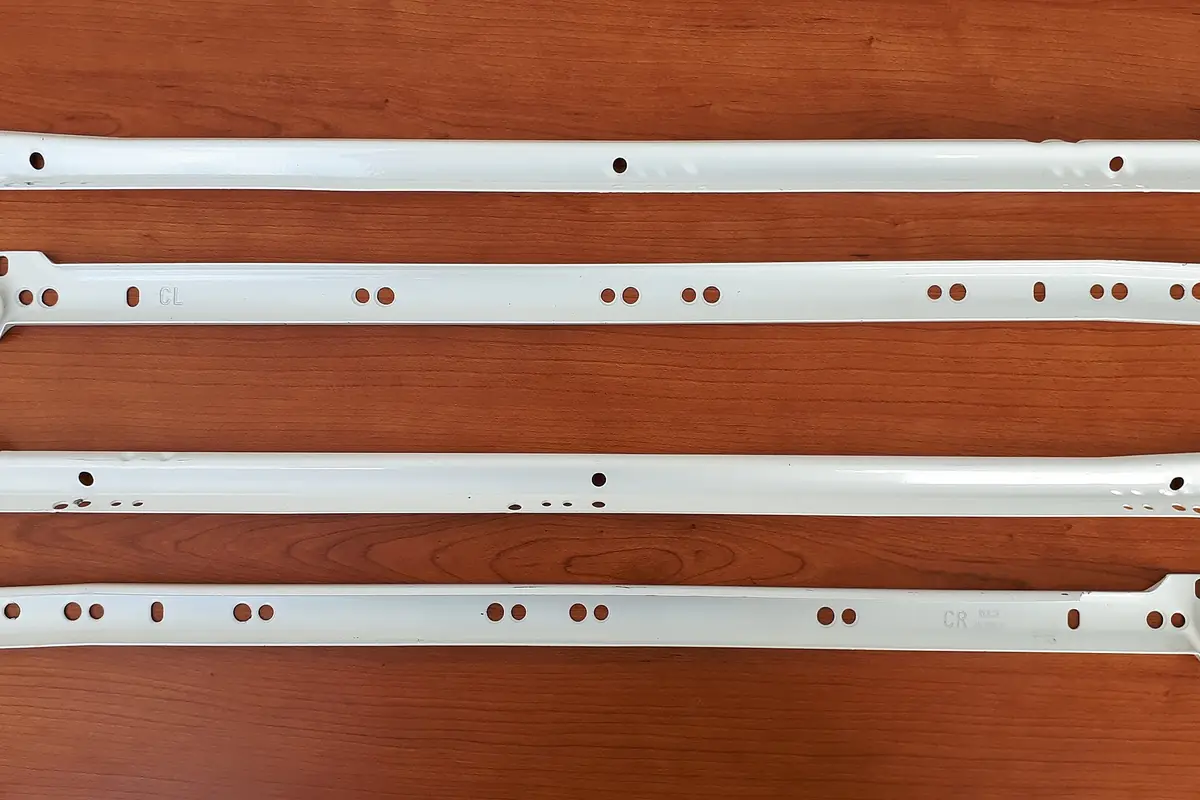
What retrofits and what does not
Three categories, and knowing which one each item falls into before quoting is what prevents a surprise on fitting day.
| Upgrade | Category | What determines it |
|---|---|---|
| Soft close concealed hinges | Usually a straight swap | Matching cup diameter and the same overlay and mounting plate type |
| Clip on hinge dampers | Almost always possible | Enough clearance on the hinge arm or the carcass side for the damper body |
| Pull-out shelves in a base cupboard | Usually fits inside the existing carcass | Clear internal opening width, measured past the face frame and the open hinge, not the nominal cabinet width |
| Pull-out waste bin | Usually possible | Opening width and the depth available past any plumbing |
| Soft close drawer runners | Often needs a new drawer box | Drawer box width and whether the existing box was built for side mount, under mount or bottom mount runners |
| Full extension runners | Often needs a new drawer box | Side clearance, because full extension runners take more width than older bottom mount rails |
| Corner pull-out mechanism | Depends entirely on the corner | Whether the corner is blind or diagonal, and the door opening relative to the mechanism |
| Under sink U-shaped pull-out | Usually possible | The position of the trap, the waste disposal and the supply stops |
Prioritising, when you are not doing the whole kitchen
Most people doing this work are not doing all of it at once, which makes the order a real question. The rule that works is frequency of use, not visibility.
The base cupboards either side of the sink and beneath the hob are opened many times a day and are almost always the deepest and darkest. They go first. The waste arrangement goes next if it is currently a bin on the floor, because that is the single interaction people complain about most. Door soft close across the whole kitchen comes after that, because it is cheap per door and it changes the character of the room.
The tall unit nobody opens, the cupboard above the refrigerator and the corner that is already written off can wait indefinitely. Spending the budget on those first is how an upgrade programme runs out of money before it has changed anything.
| Priority | What | Why |
|---|---|---|
| 1 | Pull-outs in the base cupboards nearest the sink and hob | The deepest, darkest, most used cupboards in the kitchen |
| 2 | A designed waste pull-out | Replaces the single most irritating daily interaction in most older kitchens |
| 3 | Soft close on every door | Cheap per door, and it changes how the whole room feels and sounds |
| 4 | Full extension runners on the pan and utensil drawers | Makes the back of a deep drawer actually reachable |
| 5 | A corner solution | Expensive relative to the gain, but it recovers volume that is currently dead |
| 6 | Everything else | The tall unit, the cupboard over the refrigerator, the spare bedroom wardrobe |
Weight ratings, and why they belong on the quote
A pull-out carrying tins or pans is among the heaviest loaded components in a house, applied repeatedly, every day, to a mechanism with moving parts. The runner gear has a rated capacity and that rating should be on the quote.
The usual failure is not dramatic. A runner that is under rated does not snap; it starts to bind, then to run unevenly, then to drop at the front when extended. By the time it is obviously failing it has usually been quietly getting worse for a year. Specifying the right rating at the start costs very little more than specifying the wrong one.
For the cabinet itself, the published benchmark is ANSI and KCMA A161.1. Certified cabinets have passed 14 tests including a 600 pound load test, and KCMA notes that between 40 and 50 percent fail their first attempt, which is a useful indicator of how demanding the test actually is. See the KCMA certification programme→. For the hardware, the Builders Hardware Manufacturers Association is the only ANSI accredited developer of builders hardware performance standards and maintains more than forty of them, with certified products tested for cycle, operational, strength, security and finish performance. See the ANSI and BHMA standards overview→.
What this cannot fix
Upgrades work on sound carcasses. They do not fix a swollen sink base, a kitchen laid out for a 1976 refrigerator, or doors that have warped past adjustment. Three honest limits are worth stating.
A damaged carcass. If the base of the sink cabinet has swollen, fitting a pull-out into it puts a moving mechanism into a box that is no longer square. That is work that will not last, and the right answer is a new carcass in that location even if the rest of the kitchen stays.
A layout problem. If the complaint is that the refrigerator does not open properly or that there is no landing space beside the oven, no amount of hardware fixes it. That is a cabinet schedule problem and it needs new cabinetry.
Doors past adjustment. Concealed hinges adjust in three axes, which covers a great deal, but a door that has twisted is not an adjustment problem. New doors, or refacing, is the answer there, and the hardware upgrade can happen at the same time.
The pull-out types, and which cupboard each one suits
Pull-out is a category rather than a product, and choosing the wrong type for a cupboard is the usual reason an upgrade disappoints. Six types cover nearly everything in a domestic kitchen.
| Type | Best cupboard | Why | Watch for |
|---|---|---|---|
| Single pull-out shelf | Any base cupboard with a fixed shelf | The simplest conversion and the biggest single improvement | Clear opening width, and the door hinge projecting into it |
| Two tier pull-out | Deep base cupboards used daily | Doubles the usable storage in the same footprint | Headroom between tiers; two tiers of tall bottles will not fit |
| Pull-out waste unit | The base cupboard beside the sink | Replaces the worst daily interaction in most older kitchens | Bin size; a single small bin is worse than the floor standing one it replaced |
| U-shaped under sink pull-out | The sink base | Works around the trap, the waste disposal and the supply stops | The exact plumbing layout, which has to be measured rather than assumed |
| Tall larder pull-out | A full height pantry cabinet | Brings the whole depth of a tall unit out into the room | Weight rating above all; a loaded larder unit is heavy |
| Corner mechanism | A blind corner base | Recovers volume that is currently entirely dead | Door opening relative to the mechanism, and cost relative to the gain |
What good fitting looks like
Hardware fitting is judged on three things, none of which is visible in a photograph, and all of which are apparent within a week of living with it.
Reveals that line up. The gaps around and between doors are the only reference the eye has for whether a kitchen is well made. A run of doors with reveals that vary by a couple of millimetres reads as cheap even when the doors themselves are good. Getting them consistent is an adjustment pass, not a fitting pass.
Soft close that engages at the right point. A soft close mechanism that catches too early makes a door feel sticky; one that catches too late lets it bang before the damper engages. Most hardware has an adjustment for this and most installers do not use it.
Pull-outs that run square under load. A runner pair that is not parallel will work empty and bind when loaded, and the binding gets worse over time as the misalignment wears the mechanism. The only way to find this is to load the unit and run it, which is why it belongs in the sign off rather than in a later complaint.
How the project runs
- 1Survey what you have
Framed or frameless carcasses, hinge type and cup diameter, overlay, internal clear width of each cupboard, and the current shelf arrangement. Most of this comes from two photographs and a tape measure, which is why this is the easiest cabinet job to scope.
- 2Separate what retrofits from what does not
Soft close hinges usually drop into existing drilling. Pull-out shelving usually fits inside an existing carcass. Soft close drawer runners frequently need a new drawer box. Knowing which category each item falls into before quoting is what stops a surprise.
- 3Prioritise by daily use
The cupboard you open twenty times a day deserves the upgrade before the one you open twice a week. A sensible upgrade plan converts the base cupboards nearest the sink and the hob first, and leaves the rarely used tall unit until last or forever.
- 4Specify the hardware properly
Manufacturer, series, type, extension and weight rating. A pull-out carrying tins is a loaded component and the rating matters more than the finish does.
- 5Fit and adjust
Hardware is fitted and then adjusted. Doors get their reveals squared, pull-outs get their runners aligned so they do not bind, and the self close trigger point is set on every drawer.
- 6Load and re-check
Everything gets loaded and operated before sign off, because a runner that is smooth empty and binds under load has either the wrong rating or an alignment problem, and that only shows up with weight in it.
What to check before you sign
- The clear internal opening measured on every cupboard receiving a pull-out, not the nominal width
- Hinge cup diameter and overlay recorded, so the soft close equivalent can be confirmed rather than assumed
- Weight ratings stated for every runner and pull-out
- A clear split between what retrofits and what needs a new drawer box, priced separately
- An upgrade order that follows daily use rather than visibility
- Adjustment included in the scope, because fitted and unadjusted hardware looks worse than what it replaced
- An honest view on any carcass that is not sound, rather than a mechanism fitted into a damaged box
Related: cabinet hardware, cabinet refacing if the doors are the problem too, and the full hardware guide.