Choose on movement first, appearance second
Wood changes dimension as its moisture content changes, every species does it by a different amount, and those amounts are published. That makes movement the one axis on which species selection can be made objectively, which is why it belongs first.
Appearance is a matter of taste and you will be right about it. A door that no longer closes, or a panel with a visible pale line along its edge where it has shrunk away from the frame, is a defect, and nobody is right about that. The sensible order is therefore to choose from the species whose movement your panel construction can accommodate, and then pick the one you like best from that set.
The source is the USDA Forest Service Wood Handbook, specifically Chapter 13 on drying and the control of moisture content and dimensional changes. Its Table 13-5 publishes a radial and a tangential dimensional change coefficient for every common species, expressed per one percent change in moisture content.
The sixteen species, with published figures
| Species | Radial | Tangential | What that means in a cabinet |
|---|---|---|---|
| Maple, sugar | 0.00165 | 0.00353 | The default paint grade and clear coat hardwood in this market. Hard, tight grained, and it moves more across the grain than alder or cherry. |
| Maple, red | 0.00137 | 0.00289 | Softer than sugar maple and noticeably calmer across the grain. Common in door and drawer front stock. |
| Alder, red | 0.00151 | 0.00256 | The quiet performer for stained work. Low tangential movement, takes stain evenly, dents more easily than maple. |
| Cherry, black | 0.00126 | 0.00248 | One of the most dimensionally stable cabinet hardwoods on the table, and it darkens in sunlight, which matters on a south facing Riverside kitchen. |
| Oak, white | 0.00194 | 0.00376 | Heavy, open pored, and near the top of the table for movement. Beautiful, but panels need room. |
| Oak, northern red | 0.00137 | 0.00304 | Calmer than white oak radially, still lively tangentially. The stock 1970s Inland Empire kitchen wood. |
| Hickory, true | 0.00259 | 0.00411 | The most active wood most homeowners will consider. Spectacular grain, and the least forgiving choice for a wide flat panel. |
| Walnut, black | 0.00190 | 0.00274 | Moves modestly for its weight, which is part of why it has survived as a premium cabinet wood for two centuries. |
| Poplar, yellow | 0.00158 | 0.00289 | Paint grade only. Cheap, straight, machines cleanly, and it dents if you look at it hard. |
| Ash, white | 0.00169 | 0.00274 | An oak substitute with a straighter, more even grain and slightly calmer tangential movement. |
| Birch, yellow | 0.00256 | 0.00338 | Frequently the face veneer on cabinet grade plywood. High radial movement for a cabinet wood. |
| Beech, American | 0.00190 | 0.00431 | The highest tangential figure in this selection. Rare in cabinet doors for exactly that reason. |
| Douglas-fir, coast type | 0.00165 | 0.00267 | A softwood, and the structural wood behind most Inland Empire walls. Occasionally used for rustic cabinet work. |
| Pine, sugar | 0.00099 | 0.00194 | The lowest pair on this list. Extremely stable, extremely soft, a specialist choice. |
| Redwood, old growth | 0.00120 | 0.00205 | Very stable, historically a California interior wood, now mostly reserved for exterior work. |
| Cedar, incense | 0.00112 | 0.00180 | The calmest wood here. Aromatic, soft, and the traditional lining for a cedar closet. |
Valid between 6 and 14 percent moisture content, based on the dimension at 10 percent. Higher numbers mean more seasonal movement. Source: USDA Forest Service, Forest Products Laboratory, Wood Handbook FPL-GTR-282, Chapter 13.
The chapter is published at the USDA Forest Service research archive→.
How much movement that actually is
The Handbook provides its own worked example, which is the most useful way to make these decimals mean something. A flat grained white fir board 9.15 inches wide at 8 percent moisture content changes by 9.15 multiplied by its coefficient of 0.00245 multiplied by a 3 point moisture change, which comes to 0.067 of an inch at 11 percent moisture content.
Two thirds of a sixteenth of an inch. On a single board that is invisible. Across a wide flat panel in a door, in a kitchen somebody looks at every day, it is the difference between a tight joint and a visible line, and it is exactly the sort of thing a homeowner notices in the second or third year and cannot stop noticing afterwards.
Now run the same arithmetic with a more active species. A panel of the same width in true hickory, at 0.00411 tangentially, moves nearly seventy percent further over the same moisture change. That is the whole argument for reading the table before choosing.
The honest inland moisture picture
The Wood Handbook's Table 13-1 publishes measured equilibrium moisture content by month for a list of United States locations. It includes exactly two California stations, and Riverside is not one of them. This guide is not going to invent a third.
What the two published stations do is bracket the inland valley. Coastal Los Angeles on one side, interior Fresno on the other.
| Station | Jan | Apr | Jul | Oct | Annual range |
|---|---|---|---|---|---|
| Los Angeles | 9.4% | 10.4% | 11.6% | 10.6% | 9.4 to 11.7, a 2.3 point band, wettest in summer |
| Fresno | 15.8% | 10.3% | 7.4% | 9.8% | 7.4 to 15.8, an 8.4 point band, wettest in winter |
Alternate quarters shown for width. The Handbook notes these figures derive from 30 or more years of NOAA relative humidity and temperature data, averaging morning and afternoon values. No Riverside station is published.
Notice that the two stations do not merely differ in level. They differ in direction. Coastal Los Angeles is wettest in the summer, because of the marine layer, and sits in an unusually flat band all year. Interior Fresno is wettest in winter and driest in July, swinging more than three times as far.
A Riverside kitchen behaves like neither of those exactly. That is not an evasion, it is the accurate statement, and it leads somewhere useful: the right response to an unmeasured environment is a shop that measures the moisture content of its own stock with a meter and lets it acclimatise, rather than one that reads a number off a table and hopes.
What the Handbook says about targets
Three statements from the Handbook are worth quoting in substance, because they are the practical instructions underneath all of the above.
On lumber: hardwood and softwood lumber for furniture, cabinetry and millwork usually has a final moisture content of 6 to 8 percent and can be specified to be free of drying stresses. Softwood for appearance grade uses is dried lower for furniture, cabinets and millwork, to 7 to 9 percent.
On the principle: match the moisture content of lumber as closely as is practical to the equilibrium moisture content conditions in service. That is the whole discipline in one sentence, and it is why acclimatisation matters.
On air conditioning: the recommended interior values in the chapter are based on measurements in well ventilated buildings without unusual moisture sources and without air conditioning, and in air conditioned buildings moisture conditions depend largely on the proper sizing of the equipment. In a Riverside house running air conditioning for a large part of the year, that is not a footnote.
| Use | Most areas of the US | Dry southwestern area | Damp warm coastal area |
|---|---|---|---|
| Interior woodwork, flooring, furniture, trim | 8 percent average, 6 to 10 percent for individual pieces | 6 percent average, 4 to 9 percent for individual pieces | 11 percent average, 8 to 13 percent for individual pieces |
| Exterior siding, trim, sheathing | 12% avg, 9 to 14% | 9% avg, 7 to 12% | 12% avg, 9 to 14% |
The three zones are published by the Handbook with their boundaries shown on a map figure. That map was not read, so this guide quotes the published zone values and does not claim which zone Riverside falls in.
Panel construction, which is how movement gets managed
Species choice sets how much a piece of wood will move. Panel construction decides whether that movement causes a problem. Four details do nearly all of the work.
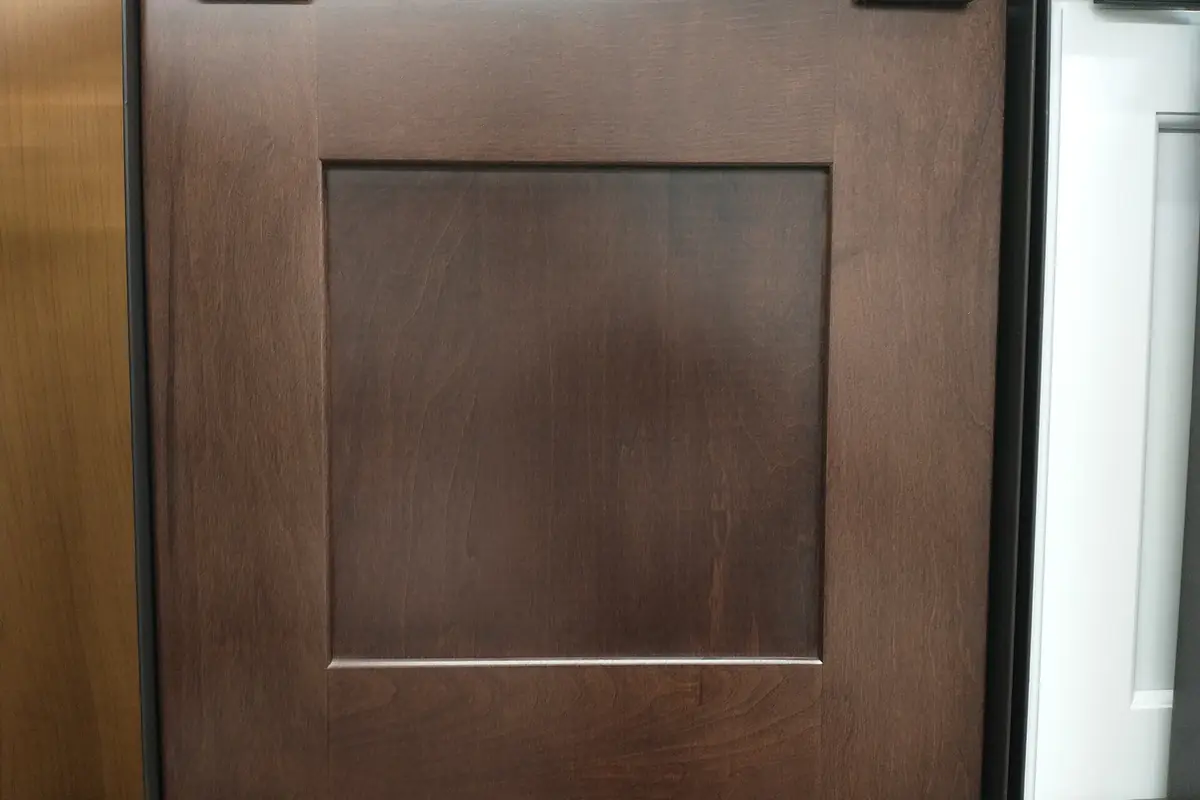
A floating panel. In a frame and panel door, the panel sits in a groove in the frame and is not glued in. It can expand and contract across its width freely. A panel glued into its frame is a panel that will either split or split the frame, and it is the single most common construction error in cabinet doors.
Narrower panels. Movement is proportional to width, so two narrow panels move half as much each as one wide one. That is why a five panel door exists, and why it is a more conservative choice than a single wide panel in an active species.
Quarter sawn stock. Quarter sawn boards move on the radial coefficient rather than the tangential one, which across this table is often less than half as much. Quarter sawn white oak at 0.00194 radially is considerably calmer than flat sawn white oak at 0.00376 tangentially. It costs more, and it looks different, and in an active species it is the thing that makes a wide panel safe.
Acclimatisation. Letting stock sit in the environment it will live in before it is machined, so that most of the movement happens before the joint is cut rather than after. This is free, it takes time, and it is the step most often skipped under schedule pressure.
A short way to choose
- Decide whether the door has a wide flat panel or several narrow ones, because that sets how much movement you can tolerate
- If the panel is wide, choose from the calm end of the table: cherry, alder, red maple, or quarter sawn stock in a more active species
- If the panel is narrow or the door is a slab in sheet material, species becomes mostly an appearance decision
- For a paint grade door, poplar or maple are the usual choices and the movement question largely goes away under the finish
- Ask what moisture content the stock will be at when machined, and whether it is acclimatised in the shop
- Ask whether panels float in their frames, which they always should
Where the coefficients bite hardest: wide panels in built in work
The species table above matters most on the widest panels, and the widest panels in a house are almost never kitchen cabinet doors. They are built in work: a media wall, a bookcase end panel, a window seat lid, a wardrobe front. Movement is proportional to width, so the same coefficient that produces an unnoticeable change across a sixteen inch door produces a visible one across a thirty inch panel.
Run the numbers on the extremes in the table. American beech, at 0.00431 tangentially, moves nearly two and a half times as much as incense cedar at 0.00180 for the same change in moisture content, and more than one and a half times as much as black cherry at 0.00248. Across a thirty inch panel in a house cycling between the Handbook target of 6 percent average, 4 to 9 percent for individual pieces and a humid summer kitchen, that is the difference between a joint that holds and one that opens.
Two sound answers and one bad one. Specify a calm species for anything wide and flat, or build it as frame and panel so the panel floats and the frame holds the dimension. The bad answer is to fix a wide solid panel rigidly along both long edges, which in an inland California house is a split waiting for its first dry winter. It is also why cabinet grade plywood is the correct substrate for a wide flat panel rather than a compromise: its cross banded construction holds its width where a solid panel of the same species will not.
Related: door styles and overlays, painted or stained, and what the box is made of.